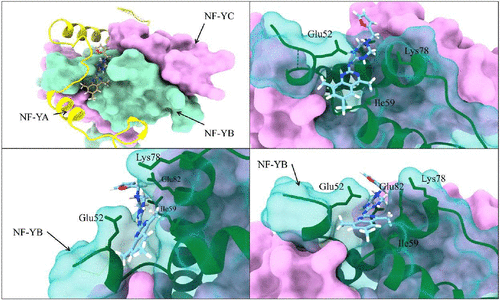
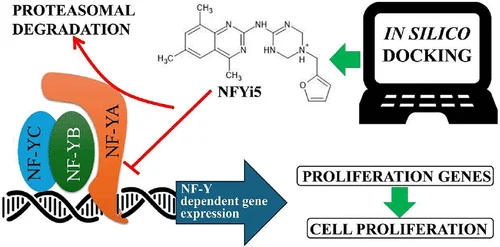
The authors targeted nuclear transcription factor Y (NF-Y), a heterotrimeric complex involved in control of genes linked to cell growth and metabolism. Transcription factors are often difficult to inhibit with small molecules; the paper describes an in silico screen to identify candidate ligands.
Using the University of Bristol BlueCrystal supercomputer and the Bristol University Docking Engine (BUDE), the team screened 160 million compound structures and advanced a hit termed NFYi5. In reported assays, NFYi5 reduced NF-Y-dependent transcriptional activity and decreased proliferation of cardiac fibroblasts, a model relevant to fibrosis. The authors also discuss literature linking NF-Y to cancer biology.

Biochemical data in the article are consistent with NFYi5 interfering with DNA binding by NF-Y and with accelerated turnover of the NF-YA subunit. The authors conclude that NF-Y may be pharmacologically tractable with further medicinal-chemistry optimisation.
For structures, assay conditions, and limitations, see Ebrahimighaei et al., Journal of Medicinal Chemistry (doi:10.1021/acs.jmedchem.5c03508).