Summary written for researchers on The Bond Lab. Primary report: Callaway & Naddaf, Nature (4 June 2026). Try ESMFold2 at Biohub.
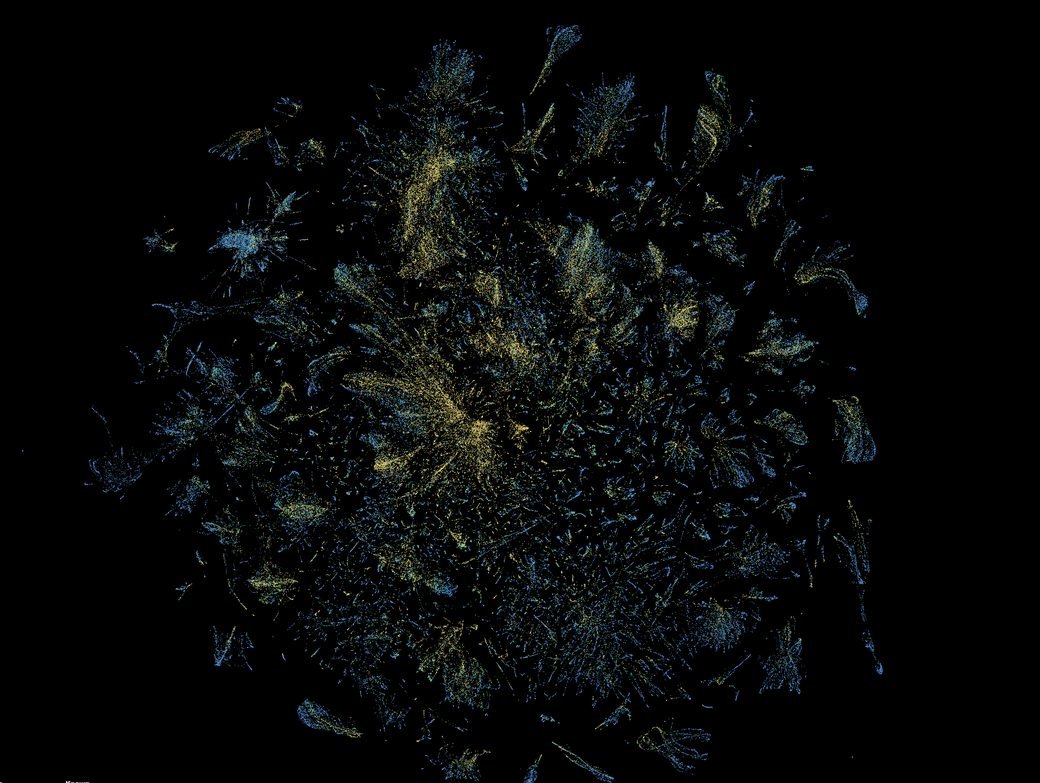
A billion proteins, mapped by an open-source model (with some caveats)
If you’ve ever tried to picture a protein, you’ve probably seen one of those ribbons-in-space renderings. Colourful tangles that look a bit like a discarded headphone cable. Getting those tangles correct is actually very hard work. It usually means crystallising the protein, zapping it with X-rays, or freezing it for cryo-electron microscopy. This can often take months of work in the lab. So when DeepMind released AlphaFold back in 2020, it felt a bit like cheating: a neural network that could guess a protein’s shape from its amino-acid sequence alone could be done in a few minutes.
Recently, a team at the Chan Zuckerberg Initiative’s Biohub in San Francisco released an updated tool called ESMFold2, along with the underlying ESM Atlas. The headline number is the one you’ve probably already seen: 1.1 billion predicted protein structures, plus another 6.8 billion protein sequences on top. For context, the AlphaFold database holds around 200 million. Most of the new sequences come from environmental samples such as soil, seawater and the contents of animal guts, that have never been grown in a lab.
The model is the latest version of a “protein language model” first published by Biohub in 2024, trained on raw sequences from across the tree of life. The team, led by Biohub science head Alex Rives, says ESMFold2 matches or beats AlphaFold3 on certain tasks, especially predicting how multiple proteins fit together, including antibodies latching onto their targets.
Antibody design that held up in the lab
This last part is the one worth paying attention to. Designing new antibodies used to be a slow, expensive guessing game. According to the report, the team used ESMFold2 to design proteins meant to bind tightly to targets involved in cancer and autoimmune disease, then actually made them in the lab. A high proportion of the designs bound the way the model said they would. That’s encouraging, though worth noting it isn’t the same as a clinical trial.
There’s also a fun lateral finding the team flags: a structural similarity between the proteins behind CRISPR, the famous gene-editing system, and a different gene-editing protein first spotted in a soil fungus in 2023. That kind of connection is easier to spot when you have, well, a billion proteins to compare against.
Open source, freely accessible
The tool is open-source, with no commercial restrictions, and the atlas itself is freely accessible. You can try ESMFold2 on Biohub. Rives frames it modestly: “What this atlas does is it shows the totality of protein biology and especially the parts that are most unknown… We think it’s going to be a really powerful substrate for the discovery of new biology.”
What other researchers are saying
Other researchers are paying attention, but with notes of caution. Gemma Atkinson at Lund University called it “an extraordinary resource for biology” and said it’s “exciting to see how large-scale protein language models can capture fundamental rules of protein biology.” Christine Orengo at UCL said the predictions could surface new protein folds, but emphasised they still need to be properly evaluated.
The biggest open question, according to Martin Steinegger at Seoul National University, is whether ESMFold2 actually works on proteins that look different from anything it’s seen before. His group found that the first version of ESMFold struggled with unusual proteins, especially those from metagenomic data, which is a slightly awkward finding, given that the new atlas leans heavily on exactly that kind of sequence.
Sergey Ovchinnikov at MIT put it plainly: he sees the ESM Atlas as a supplement to AlphaFold, not a replacement. He also pointed out that ESMFold2 isn’t the only open-source model in this space, and that Isomorphic Labs, a DeepMind spin-off, made “substantial gains” on protein-interaction prediction earlier this year. “I expect many people will be excited to try ESMFold2,” he said.
The takeaway
So: a billion proteins, mapped by an open-source tool anyone can use, with some genuinely promising antibody-design results in the lab. Just don’t throw out the crystallography kit yet.
Reference
Callaway, E. & Naddaf, M. “Move over, AlphaFold: open-source model predicts shape of 1 billion proteins.” Nature, Vol. 654, 4 June 2026. Report available at go.nature.com/3rebry7.