Summary written for researchers on The Bond Lab. See Maurais et al., Cell (2026) for the primary paper.
Human Cells May Be Passing Damaged DNA to Their Neighbours, Study Finds
For decades, biology textbooks have taught us that our DNA is carefully stored inside the nucleus of each cell, isolated from the outside world and passed down only when cells divide. New research suggests that, under certain circumstances, that picture may not be quite so tidy.
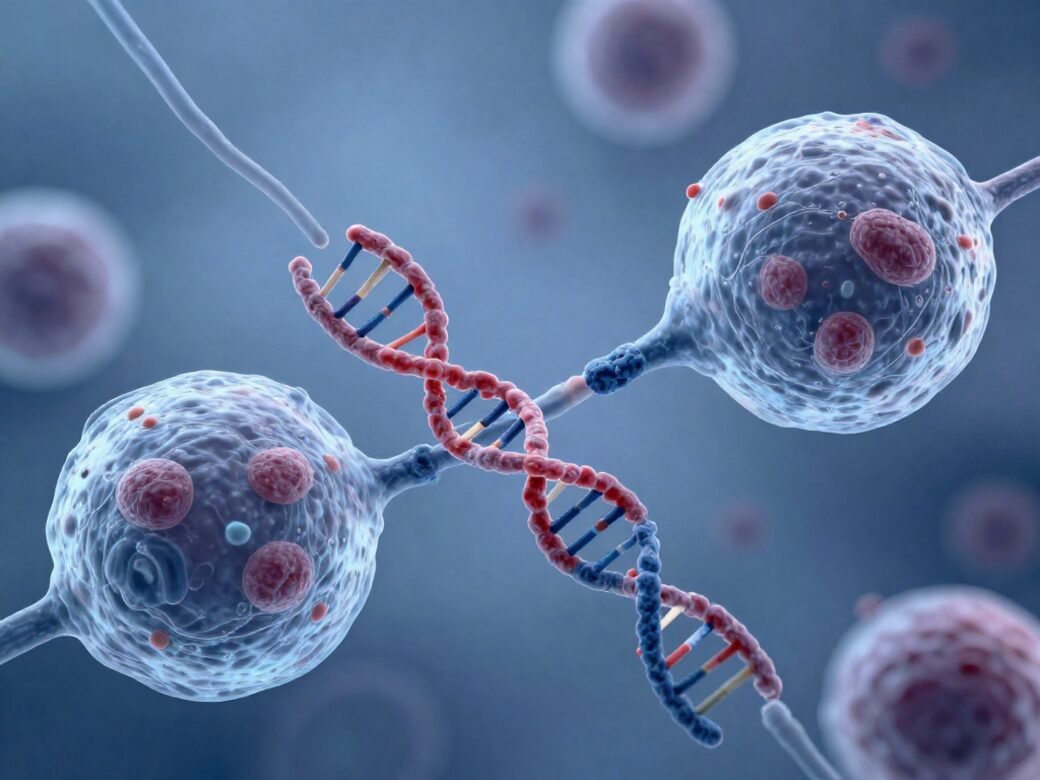
In a study published in Cell, researchers at the University of Texas Southwestern and collaborating institutions report new evidence that human cells can transfer fragments of DNA directly to neighbouring cells through tiny nanotube-like connections.
Genomic Instability and Misplaced DNA
The discovery emerged from experiments investigating what happens when cells experience genomic instability, a condition in which chromosomes are damaged, mis-segregated, or otherwise disrupted. Such instability is common in cancer cells and can also occur after exposure to radiation or other forms of DNA damage.
When chromosomes are damaged, pieces of DNA can sometimes end up outside the nucleus in the cytoplasm in structures known as micronuclei. These micronuclei have been studied extensively because they can trigger immune responses and contribute to further genetic errors. What had not been explored in detail was whether this misplaced DNA could move between cells.
DNA on the Move Through Tunnelling Nanotubes
Using live-cell imaging, the researchers observed DNA-containing structures travelling through thin cellular connections known as tunnelling nanotubes. These nanotubes act as temporary bridges between neighbouring cells and have previously been shown to transport other cargo, including proteins, RNA molecules and even mitochondria.
The team found that several different forms of genomic stress increased the likelihood of DNA transfer. Chromosome segregation errors during cell division, targeted DNA breaks created using CRISPR technology, and exposure to ionising radiation all appeared capable of generating DNA fragments that could subsequently move between cells.
Heritable Incorporation in Recipient Cells
Importantly, the transferred DNA did not simply disappear or get degraded after its arrival in the neighbouring cell. In some cases, the researchers observed DNA fragments becoming incorporated into recipient cells’ own DNA and persisting through multiple rounds of cell division. The newly acquired DNA was heritable.
To test whether these transferred fragments remained functional, the scientists engineered donor cells carrying a drug-resistance gene on the Y chromosome. After inducing chromosome instability, they identified recipient cells that had acquired the resistance trait despite originating from a different cell population. Further analyses suggested that transferred DNA fragments could survive as small extrachromosomal DNA elements and continue to produce functional gene products.
Parallels with Horizontal Gene Transfer
The findings have prompted comparisons with horizontal gene transfer, a process that is widespread among bacteria. In bacterial populations, genes can move between unrelated cells, allowing traits such as antibiotic resistance to spread rapidly. Direct equivalents in mammals have long been considered rare.
The authors are careful not to claim that human cells routinely exchange large amounts of genetic material. Transfer events occurred at relatively low frequencies in laboratory-grown cells, and many questions remain unanswered. The researchers do not yet know how cells select DNA for transfer, how often the process occurs in living tissues, or what its biological significance might be outside experimental systems.
Cancer, Drug Resistance, and Open Questions
Nevertheless, the work raises intriguing possibilities. In cancer, where chromosome instability is common, DNA transfer could potentially contribute to tumour diversity by spreading genetic changes between neighbouring cells. It may also help explain the persistence of certain drug-resistant cell populations.
At the same time, the study highlights how much remains to be learned about the complex ways cells communicate. Over the past two decades, scientists have discovered that cells exchange proteins, RNA molecules, organelles and signalling molecules through a growing variety of mechanisms. The new study “Genome instability triggers intercellular DNA transfer between human cells” by Elizabeth G. Maurais is published in Cell (doi:10.1016/j.cell.2026.04.041). It reports the phenomenon in cultured human cells and stem cells, but the authors note that its importance in living organisms remains to be established.
For now, the discovery is best viewed as an unexpected observation that opens a new line of investigation. Whether intercellular DNA transfer proves to be a rare biological curiosity or an important contributor to human disease will depend on what future studies reveal.