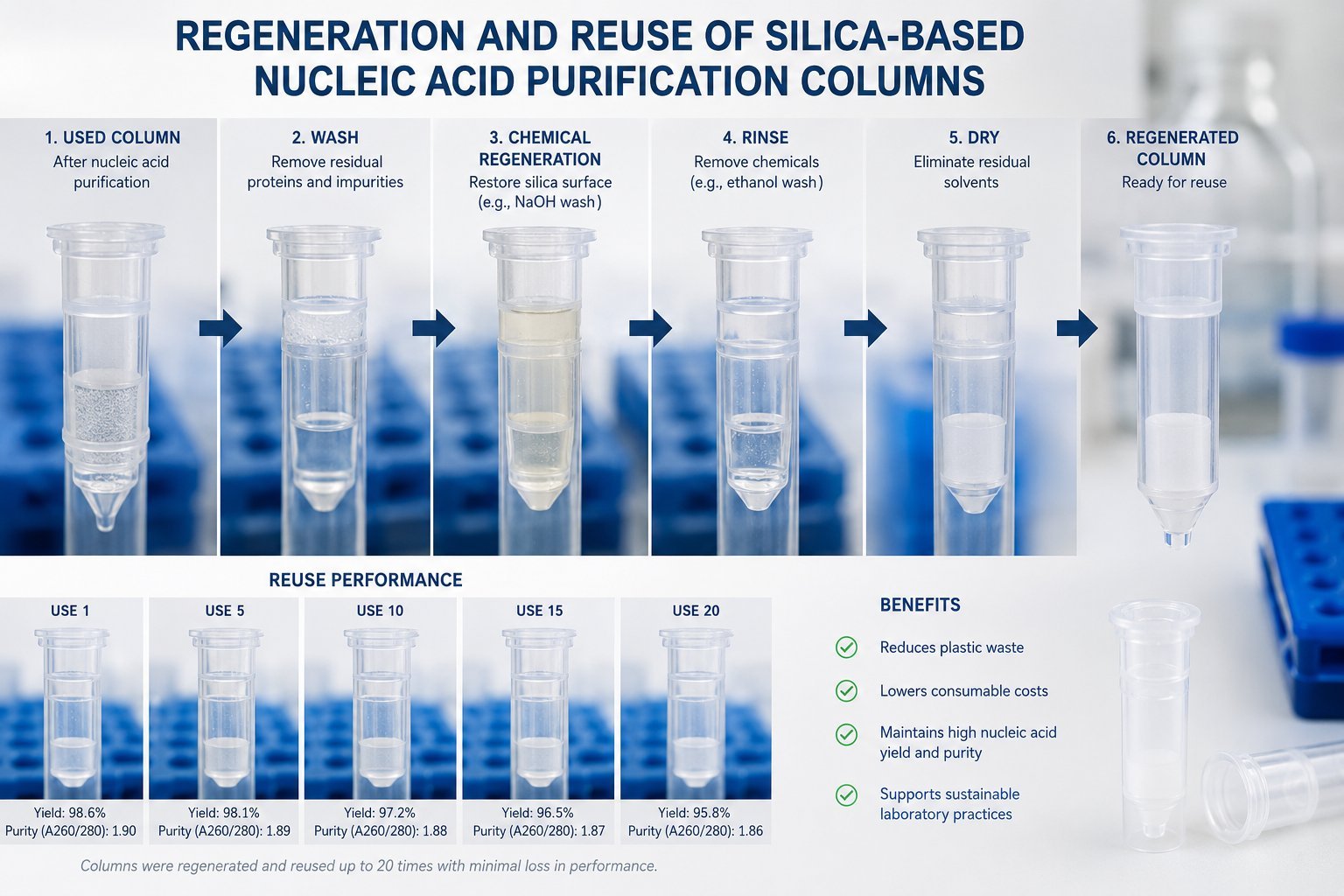
Save money by regenerating and re-using your silica-based nucleic acid purification columns
Commercially available RNA purification columns are convenient and efficient, but they come at a cost. Did you know that you can reuse them, saving a lot of money and reducing plastic waste at the same time?
Brief protocol: regeneration of RNA spin columns (silica-based)
Important notes
- Perform regeneration immediately after use to prevent RNA drying and binding irreversibly.
- Ensure RNase-free conditions throughout.
- This protocol aims to remove residual RNA and contaminants to avoid carryover.
Reagents
- RNase-free water
- 0.1–0.2 M NaOH (freshly prepared)
- 0.1% Triton X-100 (optional but recommended)
- 70–80% ethanol
- RNase-free TE buffer or water (for equilibration)
Procedure
-
Initial wash
- Add 500–700 µL RNase-free water to the column.
- Centrifuge (≥10,000 × g, 1 min).
- Discard flow-through.
This step removes loosely bound salts and residual buffer.
-
Alkaline decontamination
- Add 500–700 µL warm NaOH solution (0.1–0.2 M) (optionally containing 0.1% Triton X-100).
- Incubate 5–10 min at room temperature.
- Centrifuge and discard flow-through.
This step degrades residual RNA and removes contaminants.
-
Thorough washing
- Wash column with 2–3 × 500 µL RNase-free water.
- Centrifuge after each wash.
Ensures complete removal of NaOH (critical to avoid RNA degradation later).
-
Ethanol wash
- Add 500–700 µL 70–80% ethanol.
- Centrifuge and discard flow-through.
Helps remove remaining organics and reconditions the silica matrix.
-
Dry spin
- Centrifuge empty column 2–3 min.
Removes residual ethanol (important for downstream binding efficiency).
-
Re-equilibration
- Add 500 µL RNase-free water or binding buffer.
- Spin and discard.
Restores column to a usable state.
-
Storage
- Dry at room temperature, or
- Sealed at 4 °C (RNase-free environment).
Performance notes
- Columns can typically be reused multiple times (≈10–15 cycles) without major loss of efficiency when properly regenerated.
- The key risk is RNA carryover, so validation (e.g. blank elution control) is recommended.
Quicker method
An even quicker method is to elute your current RNA sample as usual, then wash the column with 500 µL hot (50–60 °C) nuclease-free water twice. Dry the column and re-use. After doing this, a second 50 µL elution was performed, equal volumes were reverse transcribed from the first and second elutions, and both were run through qPCR. The signal from the second elution was at least 30 Ct lower than the first elution, demonstrating minimal, if any, carryover of RNA from the first use.