Calcium phosphate transfection protocol
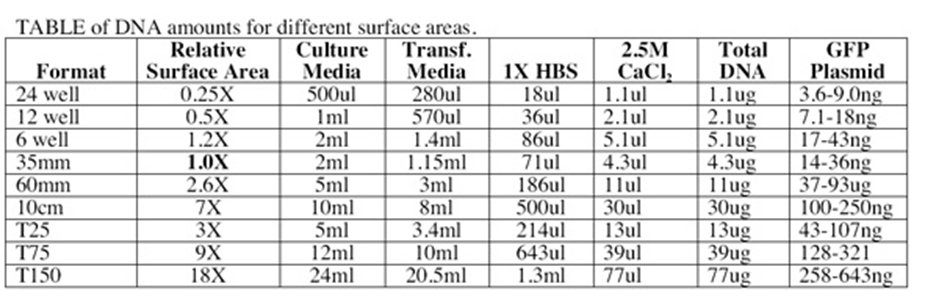
This is our lab’s calcium phosphate transfection protocol for HEK293 (293HEK) cells in 15 cm dishes: seeding density, CaPO4 precipitation, overnight incubation, and media change. The 1× HEPES buffered saline (HBS) recipe and DNA scaling table are included below.
Procedure
- Grow enough 293HEK cells in T150 flasks so that you have one T150 for two 15 cm dishes. 293 cells are normally grown in 10% FCS in DMEM (with Pen/Strep and Glu) but will also grow well in 10% FCS DMEM.
- On the morning of the day of transfection, trypsinise the cells and seed 1 T150 into two 15 cm dishes in 24 ml of 10% FCS/DMEM. Transfection must be performed in DMEM not EMEM. Do this as early as possible to allow the cells to stick down and spread.
- At about 3 pm, remove the 1× HBS and 2.5 M CaCl2 and warm up to room temperature.
-
At about 4 pm set up the transfection as below. Set up a single 1.5 ml Eppendorf for each
15 cm dish.
- Add 1.3 ml of 1× HBS.
- Add 77 µg of plasmid and mix well by pipetting up and down.
- Add 38.5 µl of 2.5 M CaCl2 and mix immediately by rapidly pipetting up and down.
- Add another 38.5 µl of CaCl2 and mix immediately by rapidly pipetting up and down.
- Incubate at room temperature for 40 minutes.
- Add dropwise to each dish. Rock back and forth so you spread the transfection mix evenly.
- The next day you should see a very fine precipitate, particularly in areas where there are no cells. You will need to use the highest magnification in TCB to see this clearly. It will almost look like a bacterial infection.
- Remove the media and replace with cold fresh media (normally 10% FCS EMEM but DMEM will also do).
- Expression will only be good 48 hours after transfection.
1× HEPES buffered saline (1× HBS)
- NaCl: 4 g
- KCl: 0.1775 g
- Na2HPO4: 0.095 g
- HEPES: 2.5 g
- pH 7.4