Collagen-coated polyacrylamide hydrogels on GelBond PAG membrane
Protocol for casting collagen-coated hydrogels on GelBond® PAG membrane for biomechanical in vitro cell culture studies — variable stiffness from the same workflow.
GelBond PAG film
GelBond® PAG Film is a transparent, flexible polyester film designed to support polyacrylamide gels. Acrylamide monomers covalently attach to the coating on the film during polymerization. Although originally designed for electrophoresis gels, the membrane can support thin PA hydrogels of varying rigidity for cell culture. PA gels remain covalently attached to the film, so you do not need to etch glass coverslips or treat with toxic glutaraldehyde.
Casting PA hydrogels
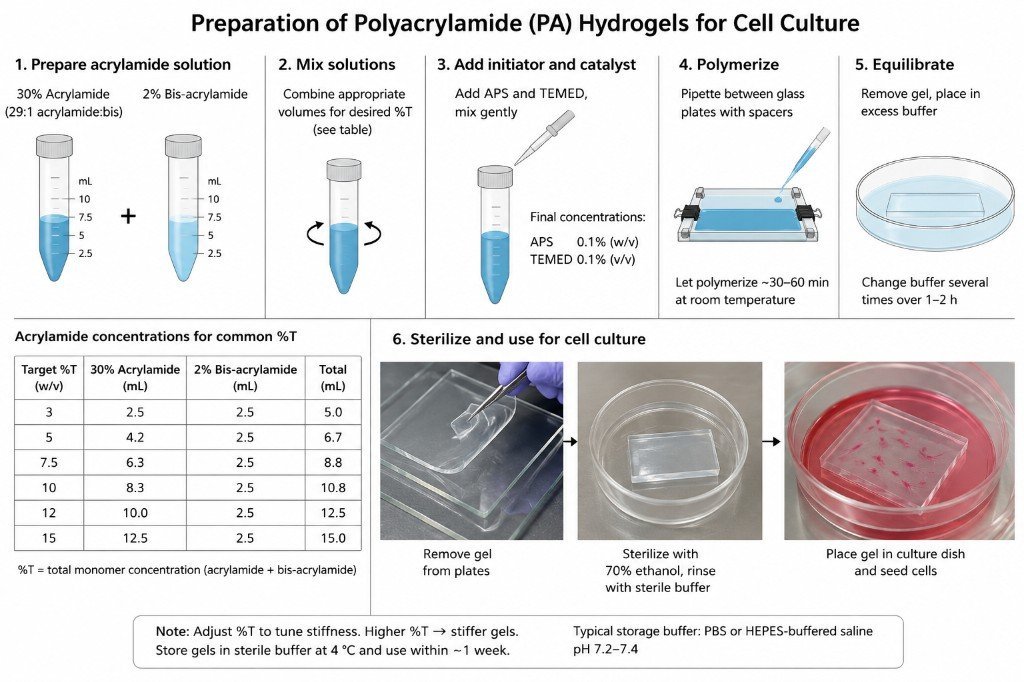
Gel mix (10 ml) — add APS and TEMED in step 7 only
| Formulation | Stiffness | 40% acrylamide | 2% BIS | Water | 10% APS | TEMED |
|---|---|---|---|---|---|---|
| Soft | 0.7 kPa | 1875 | 150 | 7915 | 50 | 10 |
| Stiff | 50 kPa | 3000 | 2875 | 4065 | 50 | 10 |
Use fresh distilled water. Confirm the 40% acrylamide stock is acrylamide only, not an acrylamide–BIS premix (both are available commercially — check the label).
- Make gel mix as in the table; do not add APS or TEMED yet.
- Cover the tube top with cling film and puncture a hole in the top.
- Degas in a vacuum chamber.
- Cut a piece of GelBond PAG membrane.
- Scratch the hydrophobic side.
- Place membrane hydrophilic side up on a clean sheet of plastic.
- Add APS and TEMED to the gel mix and mix gently by inversion. Do not shake.
- Add about 2 ml to the top of the membrane (about the size of a mini gel plate).
- Place cut X-ray film spacers on either side of the membrane.
- Lower a clean glass plate onto the gel mix, avoiding bubbles. Use the hydrophobic silanised side of the glass facing down (glass plates are scratched on the non-coated side).
- Allow the gel to set.
- Carefully remove the glass plate.
- Trim the membrane edges with clean scissors to remove any non-gel-coated areas.
- Place the gel–membrane gel side up in a clean square dish and rinse twice in fresh distilled water.
- Remove the gel–membrane and air dry.
- Mark the back (non-gel side) with R (rigid/stiff) or S (soft) so that when viewed from the gel side the letters read correctly (not reversed). Mark so every disk will carry a letter.
- Use a hole punch to punch out gel discs. Avoid areas with bubbles or damaged gel.
- Place discs gel side up into a 6-well plate. They can be stored in a cool, dry, dark place.
Collagen coating (extracellular matrix)
To coat the polyacrylamide gel with an extracellular matrix protein such as collagen, follow these steps:
- Transfer gel discs gel side up to a fresh dish containing 50 mM HEPES.
- Place onto a sheet of Parafilm gel side up.
- Thaw a 20-µl aliquot of 25 mg/ml sulfo-SANPAH at room temperature, add 980 µl of ddH2O, and mix well.
- Keep on ice.
- Add 170–180 µl to each gel. Quickly expose to UV in a Stratalinker for 6 min.
- Quickly remove gels, rinse in dH2O, blot off excess water, and repeat the UV step (step 5).
- Quickly remove gels, rinse in dH2O, blot off excess water, and invert onto a drop of ECM protein on Parafilm (e.g. collagen at 100 µg/ml in PBS).
- Place in the fridge at 4 °C overnight.
- The next day, wash extensively in PBS before cell seeding.
Reference
Related methods are described in JoVE: www.jove.com/video/52643 (DOI: 10.3791/52643).