New Bond Lab publication. See Hadfield et al., BBA Mol Cell Res. (2026) for the primary paper and the Bond Lab publications list.
Stiff Arteries May Set the Stage for Inflammation
A new study by PhD student Lily Hadfield at the University of Bristol has uncovered a molecular link between arterial stiffening and inflammation, shedding light on why ageing blood vessels may become increasingly vulnerable to cardiovascular disease.
The research, published in Biochimica et Biophysica Acta (BBA) – Molecular Cell Research (Hadfield et al., 2026), focuses on the NLRP3 inflammasome, a key component of the body’s inflammatory machinery that has been implicated in conditions ranging from atherosclerosis to diabetes and heart disease.
Linking Stiffness and Inflammation
Arteries naturally become stiffer with age, but the biological consequences of that stiffening are still being pieced together. While scientists have long known that inflammation and arterial stiffness often occur together, it has been difficult to determine exactly how one influences the other.
Hadfield and colleagues investigated how vascular smooth muscle cells, the cells that form much of the artery wall, respond when they are grown on surfaces that mimic either healthy, flexible arteries or the much stiffer environment seen in ageing and diseased vessels.
NLRP3 Priming on Stiff Substrates
The team found that cells exposed to a stiff environment produced substantially higher levels of NLRP3, effectively placing the inflammasome in a “primed” state ready to respond more strongly to inflammatory triggers. The researchers also observed increased activity of caspase-1, an enzyme that is activated by the inflammasome and involved in producing inflammatory cytokines, suggesting that stiff arteries may become more sensitive to inflammatory signals.
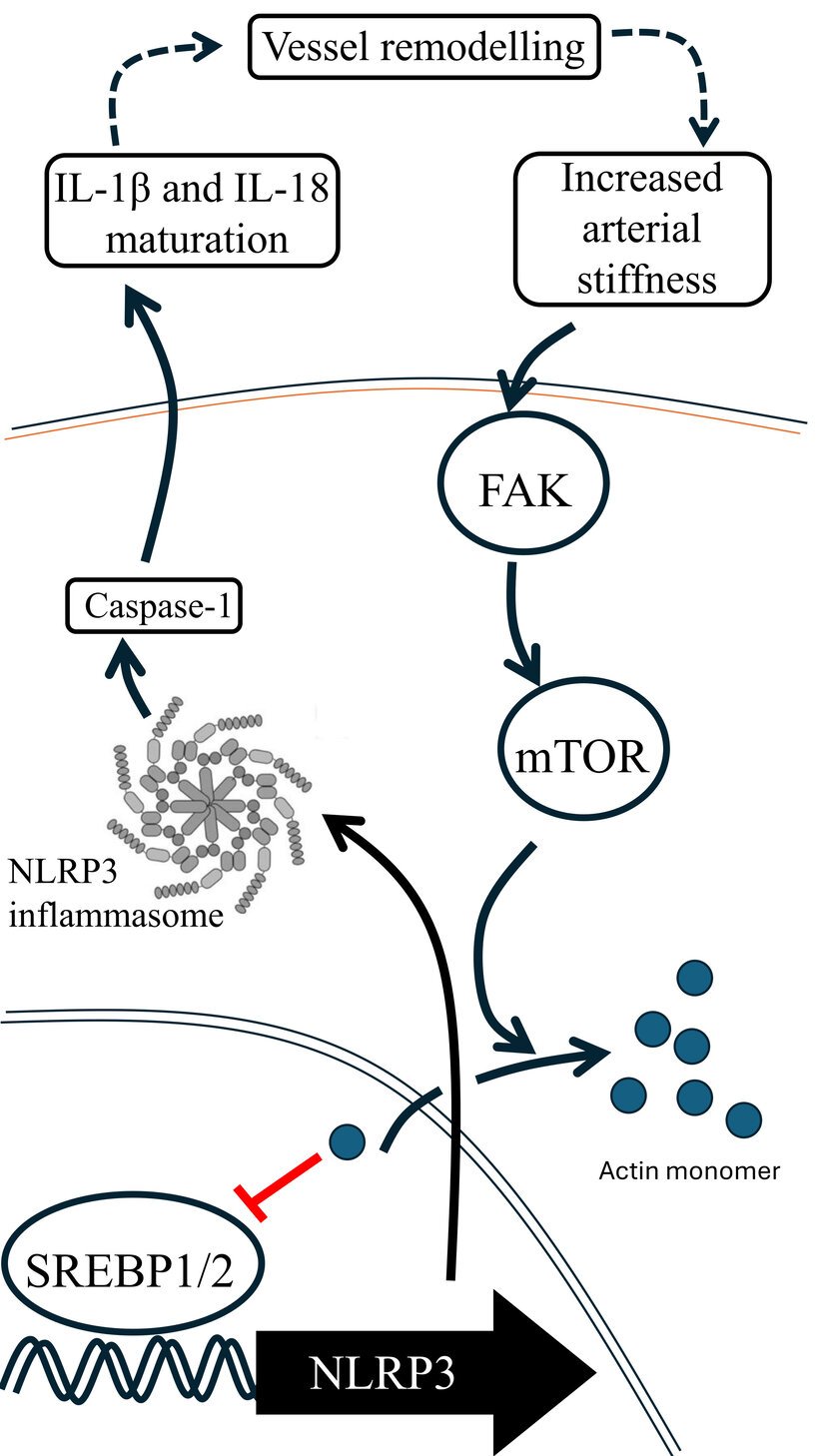
FAK, mTOR, Actin, and SREBP
Digging deeper, the researchers identified the signalling pathway responsible. Mechanical signals generated by the stiff extracellular matrix activated focal adhesion kinase (FAK) and mTOR signalling, which altered the behaviour of actin inside the cell nucleus. These changes ultimately increased the activity of the transcription factor SREBP, which was shown to drive expression of the NLRP3 gene.
“The findings help explain how changes in the physical properties of the artery wall can directly influence inflammatory gene expression,” the authors write.
Active Vessels, Not Passive Pipes
The work adds to growing evidence that blood vessels are not simply passive pipes affected by disease, but active tissues that sense and respond to their mechanical environment. As arteries stiffen with age, these biomechanical signals may create conditions that encourage chronic inflammation, potentially accelerating cardiovascular disease.
The authors suggest that the pathway they identified, linking arterial stiffness to NLRP3 through FAK, mTOR, nuclear actin and SREBP signalling, could provide new targets for future therapies aimed at reducing vascular inflammation.
The study was carried out by Lily Hadfield, Madeleine McNeill, Vealmurugan Sekar, Reza Ebrahimighaei, Andrew C Newby and Mark Bond at the University of Bristol, with funding from the British Heart Foundation. The full paper, “Extracellular matrix stiffness primes the NLRP3 inflammasome by promoting NLRP3 gene expression via FAK/mTOR/nuclear-actin/SREBP signalling in vascular smooth muscle cells,” is published in BBA Mol Cell Res. 1873:120175 (doi:10.1016/j.bbamcr.2026.120175).
While further work will be needed to determine whether the same mechanisms operate in patients, the findings offer a clearer picture of how the physical ageing of arteries may contribute to the inflammatory processes that underlie cardiovascular disease.