Reporter gene assays guide — Part 2: Types of reporter genes
Reporter genes fall into three broad families: enzymes that turn a colourless substrate into a coloured one, fluorescent proteins, or bio-luminescent protins. Each family has matured differently over the last forty years, and the choice between them is rarely about sensitivity in isolation. It is about what your experiment actually needs to do.
Colorimetric enzymatic reporters: still useful, but rarely the first choice
β-galactosidase (encoded by lacZ) was the workhorse of mammalian reporter work in the 1980s and early 1990s. It is still used in some yeast two-hybrid systems and in transgenic Drosophila and zebrafish work, where X-gal staining gives you spatial information that no luminescent assay can. The colourimetric readout (ONPG) is cheap, the substrate is stable, and the assay tolerates a wide pH range. The catch is sensitivity: you need millions of cells per well to get a robust signal, the dynamic range is narrow, and the readout is essentially an endpoint, not a kinetic one. Most labs have moved on.
Secreted alkaline phosphatase (SEAP) was Promega's clever answer to the "I want to measure the same well repeatedly" problem. Because SEAP is secreted, you can take an aliquot of supernatant, assay it, and put the cells back in the incubator. It is genuinely useful for time-course experiments on adherent cells where splitting the plate would be a nightmare. Sensitivity is decent, the substrate (CSPD or pNPP) gives a chemiluminescent or colourimetric readout, and the background is low because endogenous alkaline phosphatase is heat-inactivated in the standard protocol. The downsides: SEAP accumulates in the medium, so you cannot easily distinguish a pulse of promoter activity from a sustained one without media changes, and the assay is slower than luciferase.
β-lactamase (the FRET-based GeneBLAzer/Tango system) is the odd one out. It uses a cell-permeable substrate (CCF2-AM or CCF4-AM) that fluoresces green when intact and blue when cleaved, giving you a ratiometric readout that controls for cell number and substrate loading. This makes it genuinely useful for reporter assays where you cannot easily co-transfect a normalisation control. The chemistry is finicky, however. CCF2 loading is temperature-dependent, the substrate is expensive, and the assay requires live cells, which complicates high-throughput workflows. Most people only reach for β-lactamase when they need a FRET readout specifically.
Fluorescent proteins: when you need to see it
GFP and its descendants dominate whenever you need spatial information: where in the cell, which cells in a population, what happens to a specific subset. EGFP, mCherry, EYFP, mNeonGreen, and the iRFP series cover most of the spectrum from cyan to near-infrared, and modern variants have largely solved the old problems of folding inefficiency, oligomerisation, and pH sensitivity.
The honest limitation of fluorescent proteins as transcriptional reporters is dynamic range. A typical promoter driving EGFP gives you 5- to 20-fold induction over baseline. Firefly luciferase on the same promoter can give you 1,000-fold. If you are doing serious quantitative promoter analysis, fluorescent proteins will frustrate you. They are also slow: GFP takes 1 to 2 hours to mature, and some red fluorescent proteins take much longer, which distorts kinetic measurements.
What fluorescent proteins do well is single-cell analysis. A luciferase signal is the sum of all cells in the well; a fluorescent signal can be measured per cell by flow cytometry, microscopy, or even image cytometry. For CRISPR screening, FACS-based sorting, or anything involving heterogeneity, fluorescence is the right tool.
Luciferases: the modern default
Luciferases give you 100- to 10,000-fold dynamic range, attomolar sensitivity, and a near-zero background in most cell types. They are not interchangeable, though, and the differences matter.
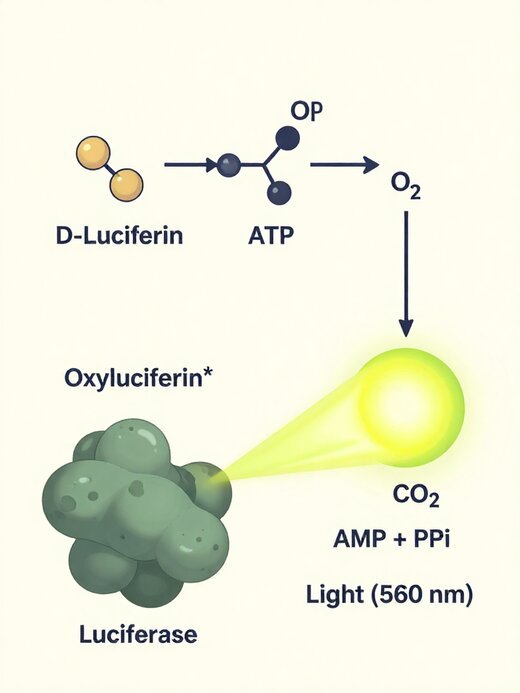
Firefly luciferase (Photinus pyralis) is the default for most mammalian reporter assays. It uses ATP and D-luciferin, has a broad emission peak around 560 nm, and works well with Promega's standard Dual-Luciferase format when paired with Renilla. The substrate is cheap, the signal is bright, and the protocols are bulletproof after 30 years of optimisation. It is a 61 kDa monomer that folds in the cytosol, does not require a secretory pathway, and tolerates most common buffer conditions. The main weakness is that the signal is pH-sensitive, which can matter in lysates but rarely matters in live-cell imaging.
Renilla luciferase (Renilla reniformis) is coelenterazine-based and 37 kDa, which is why it is almost always used as a normalisation control in dual assays rather than as a primary reporter. The signal is dimmer than firefly, the substrate (coelenterazine) is more expensive and autoxidises in light, and the kinetics are faster, so timing between substrate addition and reading has to be tighter. If you are doing a dual-luciferase experiment, read firefly first, then add Stop & Glo. Do not skip steps. Do not improvise the order.
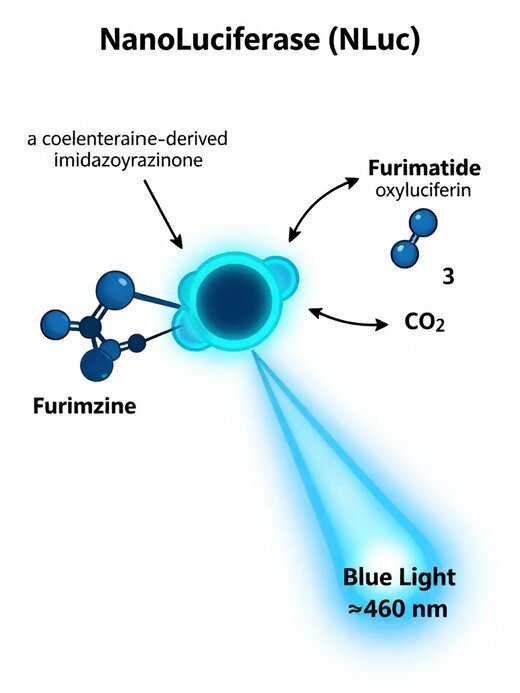
NanoLuc (Promega, 2012) is the engineered 19 kDa luciferase from Olufemi deep-sea shrimp, optimised to be small, stable, and absurdly bright, typically 100-fold brighter than firefly luciferase on a per-molecule basis with a glow-type kinetics profile. It uses a novel furimazine substrate (not coelenterazine) and emits at 460 nm. NanoLuc has become the go-to for high-throughput screens, secreted reporter work, and anywhere you need sensitivity. The main caveats: the small size means it diffuses freely, which is good for secreted assays and bad for compartmentalised ones, and the substrate cost is higher than D-luciferin. Also, the bright signal means you can easily saturate your detector. Start by diluting your lysate 1:10 or you will be measuring plate reader ceiling effects, not biology.
Gaussia luciferase (GLuc, from the copepod Gaussia princeps) is naturally secreted and gives an extremely bright flash-type signal. It is the workhorse of in vivo bioluminescence imaging in mice because secreted reporters that reach the bloodstream light up the whole animal. The signal decays quickly, so timing matters more than with firefly. Cypridina luciferase (CLuc) is a useful orthogonal secreted reporter, with a different substrate, different signal, no cross-reactivity with GLuc, and is the basis for most dual-secreted-reporter systems.
How they compare
| Reporter | Sensitivity | Dynamic range | Secreted? | Best for | Main limitation |
|---|---|---|---|---|---|
| Firefly luciferase | High | 1,000 to 10,000× | No | Standard promoter/enhancer assays, dual-luc | pH-sensitive |
| Renilla luciferase | Medium | 1,000× | No | Normalisation control in dual-luc | Dim, expensive substrate |
| NanoLuc | Very high | >1,000× | No (small, can be secreted if tagged) | HTS, sensitive detection | Substrate cost, easy to oversaturate |
| Gaussia luciferase | High | 1,000× | Yes | In vivo imaging, secreted assays | Flash kinetics |
| EGFP/mCherry | Medium | 5 to 20× | No | Single-cell, microscopy, flow cytometry | Narrow dynamic range |
| β-galactosidase | Low | 10 to 50× | No | Yeast, Drosophila, histochemistry | Low sensitivity |
| SEAP | Medium | 100× | Yes | Time-courses on adherent cells | Slow, accumulative |
| β-lactamase | Medium | 50 to 100× | No | FRET-based ratiometric readouts | Expensive, finicky |