Reporter gene assays guide — Part 3: Secreted or cellular reporters
One of the most consequential decisions in setting up a reporter assay is whether your reporter stays inside the cell or gets secreted. It is also one of the easiest decisions to get wrong, because the right answer depends on constraints (cell type, plate format, kinetic needs) that often only become clear after you have already done the experiment the wrong way.
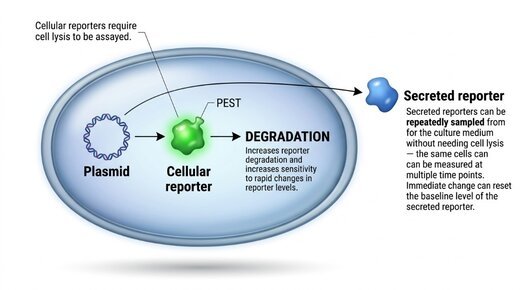
What "secreted" actually means
A secreted reporter is one tagged with a signal peptide that drives it through the secretory pathway, so it ends up in the culture medium rather than accumulating in the cytosol. SEAP, Gaussia luciferase, and naturally-secreted forms of NanoLuc (when engineered with a secretion tag) all work this way. A cellular reporter stays inside the cell, and you lyse the cells to read it. Firefly and Renilla are the canonical examples.
The distinction sounds technical, but it has knock-on effects on almost everything else: how you sample, how you normalise, how you handle time courses, what kind of plates you can use, and even what kinds of cells you can assay.
When secreted reporters are the better choice
Non-destructive, repeated sampling. This is the single biggest reason to use a secreted reporter. Because the protein leaves the cell, you can take an aliquot of supernatant, assay it, and put the plate back in the incubator. With a cellular reporter, every time you read, you lose the well. If you need a time course with, say, 6 timepoints across 8 conditions, that is 48 wells per biological replicate for a cellular reporter versus 8 wells plus aliquots for a secreted one. The labour and reagent savings are not trivial, and the inter-well variability is much lower because each well is its own time course.
Hard-to-transfect cells. Primary cells, neurons, and many differentiated cell lines transfect poorly. If your transfection efficiency is 5%, a cellular reporter will average that low signal across the 95% of untransfected cells, and your dynamic range collapses. A secreted reporter helps because the secreted protein accumulates in the medium over hours, so even a small number of transfected cells eventually produces a measurable signal. It does not solve the fundamental problem of low transfection efficiency, but it makes the assay survivable.
Cells that are difficult or impossible to lyse. Some adherent cell lines detach badly, some 3D cultures resist standard lysis buffers, and some primary cells (notably adipocytes and certain neuron preparations) are stubbornly refractory. You may be using a particular culture method that make cell lysis difficult. Secreted reporters sidestep the lysis problem entirely.
In vivo imaging. For bioluminescence imaging in mice, secreted reporters (GLuc, CLuc, or NanoLuc with a secretion tag) reach the bloodstream and light up the whole animal. Cellular reporters only emit signal from the cells that actually express the reporter, which is useful for tracking specific cell populations and useless for getting a strong total-body signal.
When cellular reporters win
Best dynamic range and signal-to-noise. Cellular reporters generally give cleaner data because the readout is a snapshot of the cell at the moment of lysis. Secreted reporters accumulate, which means your signal is a time-integrated average, not a current state. For promoter bashing, enhancer analysis, and most mechanistic work, the snapshot is what you want.
Easier normalisation with co-transfected controls. The gold-standard normalisation in reporter assays is co-transfection of a second reporter on a constitutive promoter. This is easy with firefly/Renilla pairs and harder with two secreted reporters, because you have to be careful about cross-reactivity and accurate volume measurements. Dual-luciferase (firefly + Renilla, both cellular) remains the most robust normalisation scheme in the field for this reason.
Compartmentalised readout. If you care about which specific cells in a population are responding, a cellular reporter is essential. A secreted reporter averages over all cells in the well; a cellular reporter can be coupled to flow cytometry (with a fluorescent protein) or to single-cell imaging. This is the basis of most modern CRISPR reporter screens using FACS.
Lower background. Culture medium contains phenol red, serum proteins, and other components that contribute to background fluorescence and, to a lesser extent, luminescence. Cellular assays use lysis buffer, which is much cleaner. The background difference is small for luciferase reporters but can be significant for fluorescent readouts.
Familiar, well-validated chemistry. Firefly luciferase assays have been optimised for 30 years. The substrate is stable, the kinetics are forgiving, and the lysis buffer is robust. SEAP and GLuc assays are also well-developed but require more careful timing and handling.
The kinetics problem
This deserves its own paragraph because it is the most common source of confusion for first-time users. Firefly luciferase gives a glow-type signal that is stable for tens of seconds to minutes after substrate addition. Renilla is similar but with somewhat faster decay. Gaussia luciferase gives a flash signal that peaks within seconds and decays rapidly: if you do not read it with consistent timing, well-to-well variability will eat your data. SEAP is a colourimetric or chemiluminescent endpoint assay with no real time component, which simplifies things.
If you are transitioning from firefly to a secreted reporter for the first time, the kinetics will catch you out. Pilot the assay with several different substrate-injection-to-read delays and pick the one where small timing variations cause the smallest change in signal. For GLuc, this is usually within 1 to 2 seconds of injection.
The normalisation problem with two secreted reporters
You can co-transfect two secreted reporters (GLuc and CLuc are the classic pair) and use one as your experimental and one as your normalisation control, similar to dual-luciferase. The chemistry works. In practice, the normalisation is less robust than cellular dual-luc for three reasons:
Volume handling. Aliquot pipetting from multi-well plates is less accurate than adding substrate to a lysed well. A 5% volume error between wells translates directly into a 5% normalisation error.
Different accumulation kinetics. GLuc and CLuc have different signal decay rates, different expression peaks, and different sensitivities to media components. The two reporters are not as kinetically matched as firefly and Renilla.
Media change artefacts. If you change media mid-experiment (which you sometimes have to for long time courses), you lose signal. Cellular assays with lysis tolerate this because you can simply re-normalise to the constitutive control.
For most applications, the right approach is to use a cellular reporter for your experimental readout and a separate well-matched cellular reporter (e.g. firefly/Renilla) for normalisation, or to use a secreted reporter and normalise to a DNA stain, cell viability dye, or imaging-based cell count.
Practical decision framework
| Situation | Recommended reporter type |
|---|---|
| Standard promoter/enhancer analysis in cell lines | Cellular (firefly or NanoLuc) |
| Time course on adherent cells | Secreted (SEAP, GLuc, or secreted NanoLuc) |
| Primary cells with low transfection | Secreted (accumulation helps) |
| CRISPR screen with FACS sorting | Cellular fluorescent protein |
| In vivo imaging in mice | Secreted (GLuc, CLuc, or NanoLuc-tagged) |
| 3D cultures or organoids | Secreted (avoids lysis problems) |
| Single-cell analysis | Cellular fluorescent protein |
| HTS, ≥10,000 compounds | Cellular NanoLuc or firefly (speed, cost) |
The cost of switching later is much lower than the cost of debugging a poorly-designed secreted assay because you did not want to do extra lysis steps. Optimise for the experiment, not for the benchwork.