Reporter gene assays guide — Part 4: Destabilised reporters
Should You Use Destabilised Reporters?
Most reporter proteins are remarkably stable. Firefly luciferase has a half-life of around 3 to 4 hours in mammalian cells. EGFP is effectively permanent, with half-lives in the 24-hour range. Renilla luciferase is more on the unstable side at roughly 4 to 6 hours but is still nowhere near instantaneous. This stability is a feature for most experiments but becomes a bug the moment you care about when your promoter was active rather than whether it was active at all.
Destabilised reporters address this directly by fusing a degradation tag to your reporter of choice, trimming the protein half-life from hours down to minutes.
What a destabilised reporter actually is
The standard approach is to fuse a PEST domain, a peptide sequence rich in proline, glutamic acid, serine, and threonine, to the C-terminus of your reporter. PEST sequences are recognised by the ubiquitin-proteasome system, which targets the fusion for rapid degradation. The mouse ornithine decarboxylase PEST domain (cODC, the most commonly used) gives a half-life of about 30 to 60 minutes in mammalian cells. Other degradation tags (FKBP-based dTAG, auxin-inducible degron, various ubiquitin fusion systems) give more control but require small-molecule addition.
The two most common stabilised versions in the field:
Firefly luciferase-PEST (luc2P in Promega's nomenclature): half-life roughly 1 to 2 hours, useful for tracking dynamic promoter activity in real time.
Renilla luciferase-PEST (Rluc-PEST): same idea, slightly different baseline stability.
EGFP-PEST and mCherry-PEST: destabilised fluorescent proteins with half-lives in the 1 to 2 hour range, used for flow cytometry and imaging where you want a near-real-time read on transcription.
NanoLuc-PEST variants: newer, useful for HTS where you want the brightness of NanoLuc with a tighter kinetic window.
The trade-off is straightforward: shorter half-life gives you better temporal resolution, but your absolute signal drops because less reporter accumulates at any given moment. Going from native firefly (3 to 4 h half-life) to firefly-PEST (1 to 2 h half-life) typically costs you 5- to 20-fold in raw signal, depending on the system.
When you actually need a destabilised reporter
Tracking induction kinetics in real time. If you are studying a promoter that turns on and off rapidly (pulsatile signalling, circadian rhythms, immediate-early gene responses, drug-induced transient activation) a stable reporter will smear the kinetic signature. The reporter protein made during the "on" phase will still be around during the "off" phase, lagging the actual promoter activity by several hours. A destabilised reporter reduces this lag and lets you see the true shape of the response.
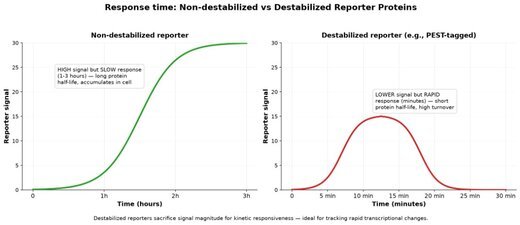
Discriminating transient versus sustained activation. Consider a drug that activates a pathway for 4 hours and then the pathway desensitises. With stable firefly, you will see a rising signal that plateaus, and the desensitisation will be invisible because the accumulated protein is still there. With firefly-PEST, the desensitisation shows up as a falling signal. This is the canonical use case in GPCR and nuclear receptor research, where the distinction between transient and sustained activation has real biological and pharmacological meaning.
Reducing background from leaky basal expression. A stable reporter on a weak promoter accumulates over time. After 48 hours, even a barely-active promoter can produce visible signal because the protein has been building up. A destabilised reporter limits the accumulation and gives a more honest read of basal activity. This is particularly useful for studying weak or tightly-repressed promoters.
Shortening assay windows in HTS. If your screen involves a short drug pulse followed by a brief recovery, you want the reporter to respond and resolve quickly. Stable reporters carry signal over from earlier time points, contaminating your measurement. Destabilised reporters let you read at a defined interval after stimulation with less carryover.
When a destabilised reporter is the wrong choice
Low-signal systems. If your signal is already weak (low transfection efficiency, weak promoter, problematic cell type) shortening the half-life will make it weaker. The math is unforgiving. A promoter that gives 5-fold over baseline with native firefly might give 1.5-fold with firefly-PEST. The biology is the same, but the assay becomes harder to run.
Standard reporter assays where you do not care about timing. If you are doing a one-shot screen of promoter mutants, a simple "is this construct active, yes or no" experiment, or a steady-state comparison between conditions, a stabilised reporter is fine. The kinetic resolution adds nothing.
Long inductions. If you are doing a 48- or 72-hour induction experiment, both stable and destabilised reporters reach a plateau. The destabilised version gives a slightly lower plateau because protein is being degraded continuously, but the steady-state signal still reflects the average promoter activity over the preceding several hours. There is no kinetic information to be gained, only lost signal.
Pathway reporters, not promoter reporters. If you are assaying downstream signalling output (e.g. a NFAT-response element driving luciferase), the relevant biology is pathway activity, not transcription rate. A stable reporter is usually the right choice, because what you care about is the integrated output.
The hidden assumption: constitutive controls
Here is a subtlety that often gets missed. When you use a destabilised reporter, you implicitly assume that the degradation machinery is not changing in your experimental conditions. If your drug treatment alters proteasome activity, and many compounds do, the apparent promoter activity will reflect a combination of transcription and degradation, not transcription alone. This is a particular problem with proteasome inhibitors, but also with anything that perturbs cellular homeostasis.
The same is true for PEST stability across cell types. Half-lives are usually measured in HEK293 or HeLa cells. Primary cells, differentiated neurons, and quiescent cell populations often have different proteasome activity, which can shift the effective half-life of your destabilised reporter by 2- to 5-fold. If you change cell type, re-validate.
Comparison table
| Reporter | Half-life (mammalian cells) | Best for | Main limitation |
|---|---|---|---|
| Firefly luciferase (native) | 3 to 4 h | Standard assays, dual-luc normalisation | Slow to track dynamics |
| Firefly-PEST (luc2P) | 1 to 2 h | Real-time promoter kinetics | Lower signal |
| Renilla luciferase (native) | 4 to 6 h | Normalisation control | Slow to resolve |
| Renilla-PEST | 1 to 2 h | Kinetic normalisation | Dim |
| EGFP (native) | ~24 h | Stable marking, FACS | No kinetic resolution |
| EGFP-PEST | 1 to 2 h | Near-real-time transcription, FACS | Lower fluorescence |
| NanoLuc (native) | Variable, often 1 to 2 h | Sensitive detection | Less kinetic resolution |
| NanoLuc-PEST variants | 20 to 60 min | Fast kinetic HTS | Very low signal |
| SEAP (secreted, accumulates) | Accumulates | Time-course accumulation | No transient resolution |
Validation before you commit
Before you commit a destabilised reporter to a screen or a major experiment, run a cycloheximide chase to confirm the half-life in your specific cell type. Cycloheximide blocks new protein synthesis; what remains is what was there at time zero plus whatever degradation happens. Measure the signal over 4 to 8 hours, fit a single-exponential decay, and you have your actual half-life. This takes one afternoon and saves weeks of confused troubleshooting later.
Also worth doing: a side-by-side comparison of stable and destabilised versions on the same promoter in your system. The ratio of their signals tells you how much your standard assay is dominated by protein accumulation rather than current transcription. A 10-fold or greater drop is a flag that the stable reporter is hiding real kinetic biology.