Reporter gene assays guide — Part 5: Choosing the right promoter
The promoter driving your reporter is the single largest determinant of what your assay actually measures. A promoter is not just a switch. It is a context-specific integration device that responds to some signals and ignores others, has a defined baseline activity, and imposes its own quirks on your data. Choosing the wrong promoter for the question you are asking is one of the most common reasons reporter assays fail or produce misleading results.
What a "promoter" actually contains
In a typical reporter construct, the sequence upstream of your reporter gene is the regulatory region. For most mammalian work, this region contains several distinct elements:
Core promoter. The minimal machinery for transcription initiation. Includes the TATA box, initiator (Inr) element, downstream promoter element (DPE), and the transcription start site. The core promoter alone gives very low, sometimes undetectable, expression.
Proximal promoter elements. Typically within 100 to 200 bp of the transcription start site. Includes GC boxes, CAAT boxes, and binding sites for general transcription factors. These elements set the baseline expression level of the promoter and are the main determinant of "housekeeping" versus "tissue-specific" patterns.
Distal regulatory elements. Enhancers, silencers, and insulators that can be located anywhere from a few hundred base pairs to megabases away from the gene they regulate. These are the cell-type-specific and signal-responsive elements that make promoters do interesting things.
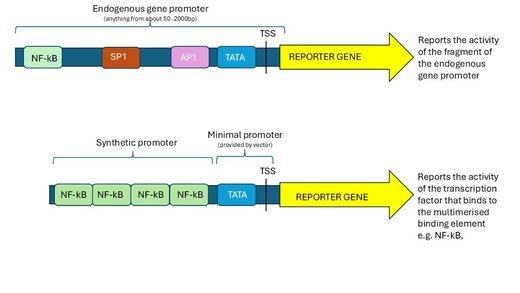
The total amount of regulatory sequence you include in your reporter construct determines how much of this machinery is captured. A "promoter" in a reporter vector might be 50 bp (just a core element) or 50 kb (a large genomic region with multiple enhancers). The choice depends entirely on your question.
Constitutive promoters: when you want consistent expression
Constitutive promoters drive expression in most cell types under most conditions, and they are used for two main purposes: as normalisation controls and as drivers of "always on" transgene expression.
CMV (cytomegalovirus immediate-early promoter) is the strongest constitutive promoter in most mammalian cells. It gives high expression in human, mouse, and many other cell lines. Its main weaknesses is that it is silenced in some cell types (notably some haematopoietic cells, primary fibroblasts, and stem cells), and its activity is affected by cell cycle stage, innate immune signalling (it contains NF-κB sites), and viral infection status. If you use CMV as a normalisation control in an experiment involving inflammatory stimuli, you are likely measuring NF-κB activation of your control, not your experimental promoter.
EF1α (elongation factor 1 alpha) is more consistently expressed across cell types and is less prone to silencing than CMV. It is the preferred normalisation promoter for most cell line work, particularly when the experimental promoter might be silenced. The expression level is lower than CMV (typically 5- to 10-fold), but the consistency is worth it.
PGK (phosphoglycerate kinase 1) and UBB (ubiquitin B) are alternative constitutive promoters with similar properties to EF1α. PGK is the most common in lentiviral vectors because of its small size and consistent expression in haematopoietic cells.
SV40 is a weaker viral promoter, mainly used historically. It still appears in many vectors as a promoter for selection markers. It is not a great choice for experimental promoters.
Tissue-specific and cell-type-specific promoters
If your experiment requires a promoter that is active only in a particular cell type (hepatocytes, neurons, T cells, muscle) you need a tissue-specific promoter. These are typically derived from genes that are highly expressed in the target tissue and have defined regulatory machinery.
Common examples include albumin (hepatocytes), synapsin or CamKIIα (neurons), CD2 or CD4 (T cells), MCK (muscle), K14 (keratinocytes), and insulin (pancreatic beta cells). Each has its own quirks, and the expression level is usually much lower than a viral constitutive promoter. Sensitivity matters in these systems, and NanoLuc or destabilised NanoLuc is often a better choice than firefly.
The other option for cell-type-specific expression is the use of enhancer elements rather than full promoters. Many cell-type-specific genes are driven by combinations of enhancers, and a single enhancer in front of a minimal promoter can give strong, cell-type-restricted expression. This is the basis of most modern cell-type-specific expression work, and the design logic is essentially the same as the enhancer-bashing assays described below.
Inducible promoters: turning the system on and off
Inducible promoters respond to a defined signal, such as a drug, a hormone, or a metabolite, and switch on or off in a controlled way. They are the right tool when you need to control when your reporter is expressed.
Tet-on (rtTA) and Tet-off (tTA) systems are the most-used inducible systems. They use a tetracycline-controlled transactivator that binds to Tet operator sequences in a modified CMV promoter. Adding or removing doxycycline switches the system on or off. The induction is typically 100- to 1,000-fold and is reversible, although the kinetics are slow (4 to 12 hours to full induction, depending on the system).
Cumate-on systems use a different repressor (CymR) and operator and have similar kinetics. They are useful when you need multiple independent inducible systems in the same cell.
HIF-responsive (HRE) promoters drive expression under low oxygen through hypoxia-inducible factor binding. They are the standard for hypoxia research and give very strong induction (1,000-fold or more) under 1% oxygen.
Steroid-responsive promoters (MMTV, GRE-containing synthetic promoters) respond to glucocorticoids and are useful for studying glucocorticoid receptor signalling. They have high background in some cell types.
Heat-shock promoters (HSP70) respond to temperature shifts and are occasionally used for controlled pulse expression.
The choice of inducible system depends on your experimental question. If you need a generic chemical on/off switch, Tet-on is the default. If you are studying a specific signalling pathway, the inducible element is built into the choice of promoter.
Synthetic and minimal promoters
A synthetic promoter is a designed sequence, often entirely artificial, that drives expression in a defined way. Common designs include:
Minimal promoter constructs: a TATA box or synthetic core promoter plus one or a few transcription factor binding sites. These are the workhorses of enhancer-bashing and pathway-specific reporters (e.g. NF-κB-responsive, p53-responsive, NFAT-responsive reporters).
Synthetic promoter libraries: randomised or designed collections of binding sites for defined factors. Used in synthetic biology to build predictable expression systems.
Logic-gated promoters: designed to respond to combinations of inputs (AND, OR, NOT gates). The field is moving rapidly and these are now used in cell engineering, biosensors, and complex screening applications.
For most standard reporter assays, a synthetic minimal promoter with well-defined binding sites is the cleanest choice. It responds to the specific signal you are studying and nothing else.
Promoter strength and signal-to-noise
A common mistake is to pick a promoter that is too strong. If your signal saturates the detector at baseline, you cannot measure induction: you are already at ceiling. If your signal is too weak, you cannot distinguish induction from background. The ideal signal-to-noise profile has:
Baseline (uninduced) signal above the plate reader background but well below the linear range ceiling
Maximum (induced) signal in the upper part of the linear range
Induction ratio of at least 10-fold for screening work, 5-fold for mechanistic work, and 3-fold for highly validated pathway reporters
Promoter strength can be tuned by:
Truncation: removing distal enhancers reduces expression
Multimerisation: multiplying binding sites increases expression
Codon optimisation: relevant for the downstream reporter, not the promoter
Insulators: boundary elements that reduce position-effect variegation in stable lines
Core promoter choice: TATA-containing versus CpG-island-containing core promoters give different expression characteristics
Genomic context: promoters versus full loci
For some applications, particularly when studying a specific gene's regulation, you want the full genomic context: promoter, enhancers, introns, and 3' regulatory elements. BAC (bacterial artificial chromosome) reporters carry 100 to 300 kb of genomic DNA, and they have been critical for studies of gene regulation in development and disease. They are harder to work with than plasmid reporters but capture the regulatory logic of a genomic locus more faithfully.
For most routine reporter work (testing a specific promoter, screening for compounds that activate a pathway, validating a ChIP-seq hit) a plasmid-based reporter with 1 to 5 kb of regulatory sequence is sufficient. Move to BAC or large-insert reporters when the regulatory logic is genuinely distributed across a large genomic region.
Choosing the right promoter for your question
| Question | Promoter type | Example |
|---|---|---|
| Is compound X a pathway Y agonist? | Pathway-responsive minimal promoter | NF-κB-Luc, p53-Luc, CRE-Luc |
| Does enhancer E activate transcription? | Minimal promoter + cloned enhancer | TATA-box-Luc + cloned element |
| Is gene X regulated by transcription factor Z? | Promoter of gene X (1 to 5 kb) | Cloned upstream region of gene X |
| How strong is promoter P in cell type C? | Full promoter | Cloned P driving reporter |
| Does treatment X induce gene Y in vivo? | Tissue-specific promoter | Albumin-Luc, Synapsin-Luc |
| What compounds activate receptor R? | Response element with minimal promoter | R-binding sites upstream of TATA-Luc |
| Is gene X regulated at a distal enhancer? | BAC or large-insert reporter | BAC with gene X + flanking elements |